A student once said, barely above a whisper, right in the middle of savasana, that my feet looked calm. I didn't feel the usual pull to curl my toes under to hide the one nail that still bothered me. Teaching barefoot six days a week puts foot care and nail health in a different category than it is for most people, since a room full of students spends an hour looking straight at your soles. What follows isn't a motivational post about feet — it's the actual breakdown of what worked, what didn't, and how I settled on a natural remedies routine I could actually stick with.
Quick disclosure before anything else: a few of the links below are affiliate links, and I earn a small commission if you buy through them, at no extra cost to you. I'm not a doctor or any kind of foot specialist — just a yoga teacher who got serious about her own nail after one too many classes spent worrying about it. Nothing here replaces an actual visit to a medical professional, especially if something looks like it's getting worse instead of better.
Reading a Toenail Before You React to It
Not every off-color nail means the same thing, and nothing here is meant to diagnose what's underneath yours. What I actually pay attention to now is simpler than I expected: the exact shade, whether the texture has changed under my thumbnail, and whether the color is holding still or creeping toward the cuticle. A static yellow patch is different information than one that keeps widening, and for a long time I treated every version of "off-color" the same way, which wasted a lot of effort for nothing.
My trail-running partner, Beckett Yun, keeps a spreadsheet for every run he does — pace, elevation, even which socks he wore — and watching him do that is probably why tracking a single toenail eventually felt normal instead of obsessive to me. We still do our loop through Mount Tabor Park most weeks, and he'll ask how "the toenail project" is going before we've even hit the first hill.
One thing that did nothing for me: diluted bleach foot soaks, a few times a week for about a month, on the advice of someone at the studio who swore by it. My guess now is that a quick soak just doesn't sit on the nail long enough to do much of anything — contact time matters as much as the ingredient itself. Either way, my nail looked exactly the same after that month as it did before I started.
Why a Surface Oil Alone Often Isn't Enough
Before the bleach experiment, I'd already gone through a long stretch with plain tea tree oil, applied directly with no carrier, and it barely touched the actual discoloration. An oil that just sits on the surface can still be a fine antiseptic step without ever reaching deep enough to change what's happening in the nail itself, which is its own rabbit hole I got into in Beyond Tea Tree Oil: My Barefoot Journey Tracking What Actually Works for Stubborn Toenails. Whether a particular stain is old trauma from stubbing a toe mid-flow or something else entirely is a separate question too, and not one I'll try to untangle here.
Kerassentials was the first thing that felt structurally different from what I'd tried before. It's still an oil-based formula, but thicker and more deliberate, something you brush on rather than drip and hope for the best. That heavier texture is a big part of why it actually stayed put through a sweaty class instead of wearing off by the second sun salutation.
Keeping the Mat and Tools From Working Against You
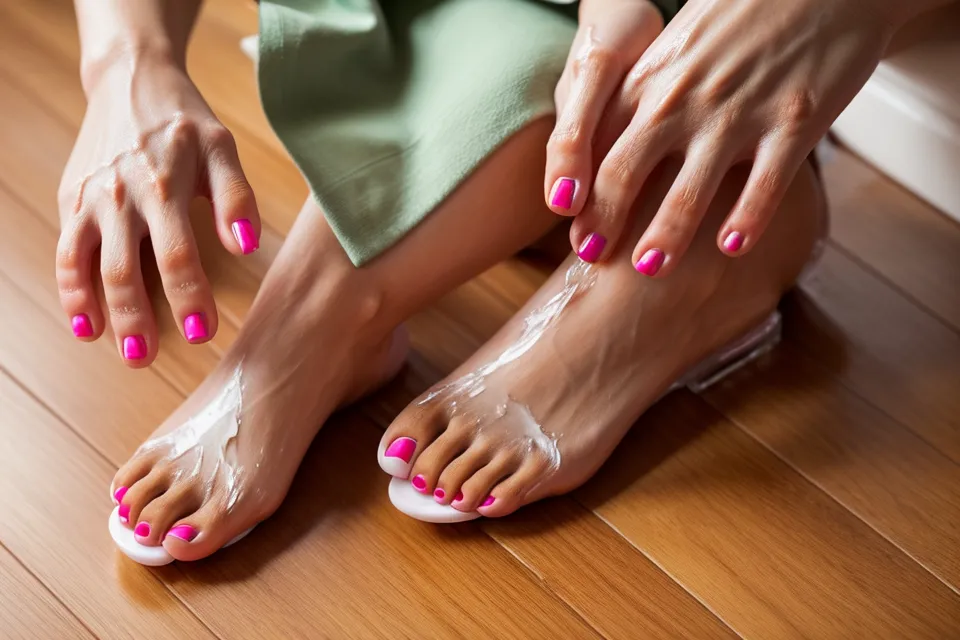
None of this matters much if the environment keeps reintroducing the same problem. I started wiping my mat down after every single class instead of only when it smelled like it needed it, since a mat that never fully dries can undo weeks of topical work without you noticing. Pedicure tools follow the same logic — anything that touches your nails at a salon or at home should be properly cleaned between uses, not just rinsed and reused, and that one habit alone probably mattered as much as any oil I ever applied.

Topical Nail Health Routines for an Active Teaching Schedule
The actual application happens at home now, not at the studio. I do it sitting on the edge of the old tub in my bathroom, foot propped on the rim, working the brush along the nail the same way every time so I don't skip a section. Before the oil goes on, I'll sometimes run a pumice stone over the callus on my heel first, and there's a specific, almost satisfying drag to that, rougher than you'd expect, like sandpaper catching on itself, that makes the whole few minutes feel less like a chore and more like something I'd do anyway.
Waiting is the hard part, and it takes longer than most people want to hear, which is most of what I get into in The Barefoot Teacher's Reality Check: My Journey from Hiding My Toes to Real Nail Recovery. Patience here works a lot like holding a long pose: nothing visible happens for a while, and then one day something has clearly shifted.
Topical or Oral: How I Actually Decide
Not everyone wants to rely on something external to fix an external problem, and that's a fair instinct — plenty of people would rather support things from the inside and let the surface follow on its own. Keravita Pro is the capsule route, built around ingredients like garlic and turmeric that show up constantly in inside-out wellness talk, and it fits best if you don't mind a slower, quieter kind of commitment where you're not watching a brush do visible work every night. If you want something that still feels topical but less greasy than an oil, a probiotic spray like ProNail Complex works through a completely different mechanism and dries fast enough that it won't leave a mark on bamboo flooring or a mat edge.
What Actually Changed in My Approach to Natural Remedies
A toenail doesn't flip from yellow to pink overnight, and that expectation is probably what makes people quit before anything visible happens. If you want one place to start, the topical that's stayed in my rotation the longest is Kerassentials, mostly because the oil-based formula holds up through an actual class instead of rubbing off in the first ten minutes. ProNail Complex is a solid alternative if you'd rather spray than brush, especially if you're splitting time between studios and showers all day. And Keravita Pro is worth a look if the inside-out capsule approach appeals to you, even though it asks for more patience before you see anything change on the surface.
Whatever you pick, a toenail grows on its own timeline, not yours, and rushing the process usually just means starting over. Be consistent instead of perfect, keep your mat and your tools as clean as your actual nail care routine, and give whichever option you choose an honest, full stretch of time before deciding it isn't working. If you're ready to stop curling your toes under in class, the current details on Kerassentials are on their official page, linked below.
Kerassentials
Pros
- ● Oil-based formula stays on the nail even during active yoga sessions
- ● Includes a mix of tea tree and lavender that I could actually verify
- ● Very easy to apply directly with the brush applicator
- ● Doesn't leave a residue on my yoga mat once it sets
Cons
- ○ Requires a solid 2-month commitment before you see the 'pink' growth
- ○ The brush needs a quick wipe after use to keep the bottle clean